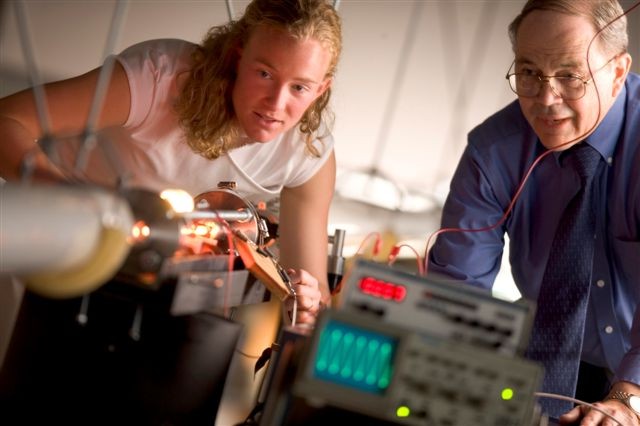
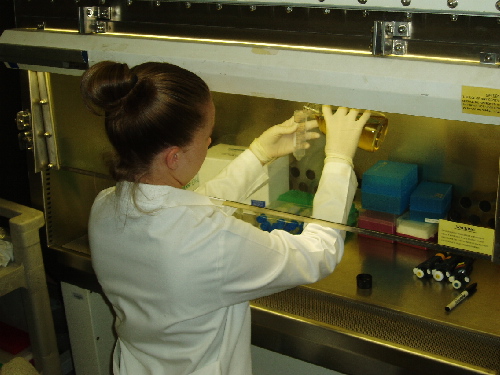
Undergraduate Research is a crucial component of the Hendrix College experience and opportunities for such research exist in every department on campus. As part of the Hendrix committment to engaged liberal arts education and life-long learning, the Hendrix faculty encourage students to engage in their own research as well as involving students in faculty projects. Undergraduate research helps students to develop their own voices and to contribute to the marketplace of ideas as they deepen their own understanding of the topics under consideration. At Hendrix, students are seen as fellow-participants in inquiry and the remarkable work being done by our students reflects this vision of collaborative engagement. Hendrix students are frequent participants in the National Conferences on Undergraduate Research, recipients of Student Undergraduate Research Fellowships (SURF), frequent winners of Fellowships and Scholarships related to research, and often co-authors on publications for professional journals.
For more information on undergraduate research at Hendrix, please explore the departmental websites that detail in more depth the work being done in those areas (links are provided to some such departments below, but this is only a selection of the amazing work being done - students interested in other areas should consult the department in which they are interested). See also the Odyssey Office, which provides substantial funding for undergraduate research.
Announcements:
Congratulations to Colin Hoy, Sarah Thompson, and Annie Greenaway who were selected as 2011 Goldwater Scholars. Congratulations also to Erik Istre who as listed as an Honorable Mention for the Goldwater.
Resources:
Hendrix Odyssey OfficeCouncil on Undergraduate Research
National Conferences on Undergraduate Research
SURF Fellowship
National Science Foundation Undergraduate Research Opportunities
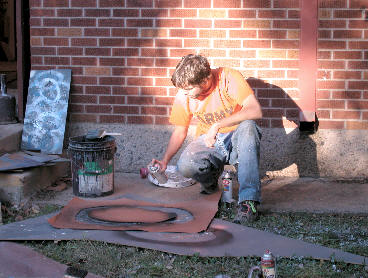
In the last few years, Hendrix students have done original research on such topics as prostate cancer, prenatal steroids, sleep habits, ponderosa pine trees, cultural stereotypes, coral snake venom, post-liberal political theory, and much more! Below are simply a sample of the various projects that have occured in recent years.
- Dr. Jennifer Peska worked with five students (RoShunna Lee, Chance McDermott, Cheslea White, Federica Gill, and Joy Stegall) on a research project examining the relationship of sleep hygiene and sleep quality to stress and burnout among college students that was presented at the 2010 (24th Annual) meeting of the Associated Professional Sleep Societies (SLEEP) in San Antonio, TX this June. Each student also added a component of their own interest (caffeine use, personality, migraine headaches, and social support) to the study and presented that work at the National Conference for Undergraduate Research or the Arkansas Symposium for Psychology Students.
- Dr. Leslie Zorwick has supervised a variety of different projects. Below are just a sample:
- Abby Blaney, Leigh Bondurant, Jordan Cacici, Liz Fasterling, Dietlinde Heilmayr, Brittney Reynolds, Tori Todd, and Alex Woody: Conducted research with Dr. Leslie Zorwick about stereotypes of Southerners
- Kendra, Anderson, Elli Betlach, Kiley Gottschalk, Emily Lenard, Melanie Morse, Blair Sanning, and Christy Wilkerson: Conducted research with Dr. Leslie Zorwick on how stereotypes can affect behavior
- Leigh Bondurant, Nate Carnes, Andrew Head, Julia Maschmann, and Alex Woody: Conducted Research with Dr. Leslie Zorwick on how group membership affects perceptions of procedural fairness
- Dietlinde Heilmayr: Conducted research with Dr. Leslie Zorwick to study the Contact Hypothesis of prejudice reduction in Urban Debate League settings. Resulted in a publication: Zorwick, M. L. W., Wade, M. M., & Heilmayr, D. P (2009). Urban debate and prejudice reduction: The contact hypothesis in action. Contemporary Argumentation and Debate, 30, 29-39.
Religious Studies
The Department of Religious Studies hosts an annual Undergraduate Conference on Religious Studies. For more information, please contact Dr. John Sanders.
Biology
- With Dr. Ann Willyard:
Kristen Finch - “How distinct are the geographically isolated coastal populations of ponderosa pines in the Willamette Valley of Oregon and Fort Lewis, Washington?” Summary of Project: This project concerns two geographically isolated populations of ponderosa pines in the Pacific Northwest (Willamette Valley, OR and Fort Lewis, WA). Previous researchers have suggested that these populations are very different, but have been unable to find evidence for or against this hypothesis. I will use new techniques and new sampling to test whether these two populations are: 1) related to the ponderosa of Eastern Washington and Idaho; 2) related to the geographically distant pines of coastal California; or 3) genetically distant form all other ponderosa pines. My work will identify their recent biogeography, as well as use new methods of species delimitation to shed light on this open question. Many native plant species, including ponderosa pine, are disappearing due to habitat loss, but there is still so much to learn about them and their ancestry. My purpose is to not just conduct research but to contribute new information to conservation efforts for preserving this native species.”
- With Dr. George Harper:
Anna Giles - "Variance of Batesian mimicry patterns of L. t. amaura (the Louisiana Milksnake) in response to multiple coral snake models." Description: A number of harmless snakes in the Americas strongly resemble venomous coral snakes and are thought to gain protection from predators by doing so. Such relationships (called Batesian mimicry) require three components: 1) a distasteful or dangerous species to serve as the model, 2) a harmless species to serve as the mimic, and 3) predators that cannot easily discriminate between the two species. Coral snakes fill the role of model very well because they are brightly and distinctively colored and they very dangerous to other animals due to the neurotoxic venom that they possess. The Louisiana Milksnake (Lampropeltis triangulum amaura) has the same bright colors and a similar appearance and is thought to be a Batesian mimic. Interestingly, the range of the Louisiana Milksnake partially overlaps the ranges of two different coral snake species, the Eastern Coral snake (Micrurus fulvius) and the Texas Coral snake (Micrurus tener). Co-occurring with two different models should have an effect on the color pattern of L. t. amaura if it is a mimic of both species. Anna will be analyzing the color pattern of L. t. amaura and each of the two coral snakes where they co-occur. To do this, Anna will travel to museums in Louisiana and Texas and photograph preserved snakes from all three species. She will then measure the color characteristics of each snake and look to see how L. t. amaura’s color pattern changes in relation to the presence or absence of one or both of the coral snake species.
- With Dr. Randall Kopper:
- Charles David Allen - "Variation of Enzyme Components in Coral Snake Venoms" Coral snakes are a group of highly venomous species of the family Elapidae found in North, Central, and South America with highly dangerous neurotoxic venom. Snake venom is a complex mixture of enzymes used by snakes for self-defense and food acquisition. Most published studies of snake venom composition are based on the analysis of pooled venom from several individuals. This provides larger sample volumes for study but can mask individual differences. This study will investigate the relative activity and regeneration of two important enzymes in venom from individual coral snakes. Acetylcholinesterase hydrolyzes the neurotransmitter acetylcholine resulting in impaired nerve conduction and paralysis. Hyaluronidase degrades hyaluronic acid that makes up the extracellular matrix resulting in general tissue destruction and increased permeability of other venom components. Through the analysis of venom from captive and wild snakes, differences in the levels of these two key enzymes will be studied as a function of environmental and physiological factors such as gender, age, ontogeny, diet, geographic location and predation pressure. Any synergistic relationship between these two venom components will be of special interest. The results will contribute to our understanding of the ecology and evolution of snake venoms, particularly the relationship between environmental factors and the variable biosynthesis of venom components.
- With Dr. Varsha Kaushal:
- Avery Roller – “Determining the Role of Autophagy in Prostate Cancer using the pten-Deletion Mouse Model” Autophagy, the process of self eating by cells, is emerging as an important mechanism to control the growth and spread of cancer tumors. The objective of this research is to determine whether autophagy suppresses or fosters tumor progression in the mouse model of prostate cancer. Initially the status of autophagy will be assessed in prostates from wild type and prostate-specific pten-deleted mice that initiate tumor formation and progress to develop metastasis. This will be accomplished by staining sections of the tissue using LC 3-II antibody and immunohistochemistry techniques. Following this, a group of mice will be treated with a suppressor of autophagy, chloroquine, or an inducer of autophagy, 2-deoxyglucose, through the water supply of the mice. The treatments will be issued for four weeks once the mice are at least eight weeks old. After the treatment has concluded, the prostate of the mice will be extracted after four weeks. The effects of chloroquine and 2-deoxyglucose on autophagy, proliferation and apoptosis will then be evaluated using immunohistochemistry and western blot analysis. Results from these studies may provide clues to possible contributions of autophagy in cancer progression and give insight into possible targets for disease treatment. The project will be completed by March 2011 and all findings will be presented at the American Association for Cancer Research in April at Orlando, Florida.
Philosophy
The Philosophy Department takes students annually to the MidSouth Philosophy Conference at the University of Memphis. Additionally, the Philosophy Department participates annually with Rhodes College, Millsaps College, and Christian Brothers University in the Tri-State Liberal Arts Philosophy Symposium.
Art
Students in the Art Department are frequent participants in the Arkansas Area Art History Symposium and also the British Studies Symposium.