|
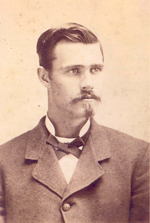
A. C. Millar during his days at Central College in Fayette, Mo.
|
Alex, as his family called him, was a remarkable young man. Yet he was far less a child prodigy than he was a naïve country boy determined to get off the farm—and take his family with him. Born in McKeesport, Pa., in 1861, only a month after the start of the Civil War, he grew up on his father’s Missouri farm and attended school for only three months a year. The rest of the time he plowed, fed stock and dug potatoes.
Alex’s mother, the former Ellen Caven, came from a prominent family in Allegheny County, Pa. Her father was the sheriff, and her mother’s father was a merchant who owned a salt works and several other businesses. Ellen’s brother John had moved to Indianapolis, where he was elected mayor twice and where he made a pile of money.
Alex’s father, William John Millar, was cut from different cloth, and until Alex reached adulthood, the Millars were sliding down the social scale with alarming speed. William helped out in his family’s coal business and worked in a foundry that built iron steamships. Then he set up shop as a druggist, a profession that at the time required no formal training. He was forever inventing gadgets and applying for patents, but none of them seem to have paid off. And so, like many of his fellow Americans, William John Millar decided to head west to seek his fortune.
He bought a small farm near Brookfield, Mo., in 1867 and moved there with his wife and small sons. Alex’s brother Charles was born in 1864 and George in 1870. When Alex was 11 and Charles 8, William wrote his father back home that the two older boys were working hard and eating like fattening hogs.
Young Alex took pride in his strength and physical prowess. He broke colts and drove fence posts with a 30-pound maul. But by the time he turned 16, he was hell-bent on self-improvement. He studied at home for a year, passed the high school entrance exam, and entered Central College in Fayette, Mo., when he was 19. (Like many small colleges at the time, Central also offered preparatory courses.) After only one semester of college-level classes he started teaching English and German in a private academy.
It was hard for the Millar family to keep Alex in school—all hands were needed on the farm and tuition was $31 a year, more than they could scrape together even with Alex’s teaching salary. A sympathetic aunt sent $50. Before long, Alex was pushing his father to send his younger brother Charlie to college. Charlie “must not be neglected longer,” Alex scolded, “and will not be, if I have to dig potatoes for a year or two to help him on.” Taking another brother away from the farm work strained the family’s resources to the limit, but when Alex decreed that something should be done, the family fell in line. Charlie was sent off to school, and Alex graduated from Central College in 1885.
Slang, and How it was Slung