From Baseball to Biology, Rwandans embrace American experience
By MARK SCOTT
Director of Media Relations
Pierre Urisanga watched carefully as the student in front of him at the Hulen Cafeteria strategically put together a hamburger. The meat and cheese go inside the bun? And lettuce and tomatoes, too? Such a novel concept, he had to try one for himself, and with the first bite he became infatuated with the popular college cuisine.
A memorable first experience eating at Hendrix, it wasn’t long before he branched out and found his true fast-food love: The Big Mac. “That’s the best,” the Rwandan student responds when asked about his favorite American food.
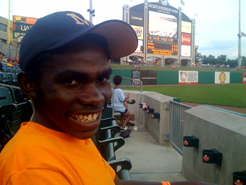 Pierre’s first year at Hendrix was dotted with variety of firsts – his first baseball game, his first ice storm, his first trip to the beach – and a challenging course load that perhaps weighs more heavily on him than the typical Hendrix student. Pierre will use his degree to rebuild his country.
One of 20 students from Rwanda now attending Hendrix, Pierre is part of the Rwandan Presidential Scholars Program, a partnership that began in 2007 between Hendrix College and Rwandan President Paul Kagame as an effort to provide American college educations to future leaders of the central African country. An educated workforce, from doctors to engineers to research scientists, is needed in the central African country ravaged by a bloody genocide in 1994.
A Hendrix-led higher education consortium with Rwanda was the brainchild of David Knight ‘71, the chief legal council at Stephens Inc. and a member of the Hendrix College Board of Trustees. Knight worked with Hendrix President J. Timothy Cloyd to begin Hendrix’s relationship with Rwanda, and both men have been instrumental in recruiting new colleges to the consortium during the past two years.
Beginning at Hendrix College in 2007 with four Rwandan students, the program’s consortium grew in 2008 to include the University of Arkansas-Little Rock, Harding University in Searcy, Philander Smith College in Little Rock, Ouachita Baptist University in Arkadelphia and Wofford College (S.C.). This year, University of Arkansas-Fayetteville, Henderson State University in Arkadelphia, Lyon College in Batesville, Southwestern University (Texas), Birmingham Southern (Alabama) and Sewanee: The University of the South (Tennessee) joined the consortium.
In all, 81 students are now earning college degrees through the innovative program.
Rebuilding Rwanda
In addition to the loss of more than a million lives, one of the most devastating consequences of the genocide in Rwanda was the near-total destruction of the country’s government and private sector infrastructure. Almost all of the senior government officials, educators and business leaders were killed or driven out of the country by the perpetrators of the genocide. And while the Rwandan government has been successful in establishing a politically stable and secure environment over the last decade, the process of identifying, recruiting and training new leaders has proven to be an understandably slow and laborious process. This program is a key response to this critical need, and its importance to the future development of the country is evidenced by the government’s major, long-term investment in this program.
The Rwandan government has initially chosen math, physics, chemistry and biology as the areas of primary focus for the program. Pools of scholarship candidates are established based on national high school test scores, and representatives of the consortium colleges then travel to Rwanda each spring to interview prospective students. It’s an intriguing and thorough process, as students are selected based on their ability to succeed in such a rigorous educational pursuit.
Pierre and other Rwandan students were initially surprised by the breadth and depth of the liberal arts curriculum at Hendrix. In Rwanda, physics students only study physics; but here, students are exposed to electives and other educational requirements that expand their knowledge. Pierre chose to take a public speaking course during the college’s Maymester program, which he said enlightened him to a different communications dynamic. He put his newly-enhanced communications skills to quick work, interning in the college’s Office of Communications and Marketing and participating in feature interviews conducted by a National Public Radio affiliate and a Little Rock newspaper. He also volunteered to work with the college’s Alumni Office for the annual Hendrix Night at the Travelers event, which exposed him to his first professional baseball game.
Campus Life
Peter Gess, Hendrix’s director of international programs and the facilitator of the Rwandan Presidential Scholars Program, knows what it’s like to be a stranger in a foreign country. As a Peace Corps volunteer just out of college, Gess flew to Poland for an assignment and initially stayed with a family that couldn’t speak English. Gess’s inability to speak Polish made communication quite interesting.
Through Gess’s leadership, the consortium has provided an intensive English summer program for the Rwandan students to help them enhance language skills and better prepare them for their classroom experiences. The program has allowed these students to “hit the ground running,” Gess said, which made for a much smoother transition to college life. This past summer, students also participated in the three-day Rwandan Presidential Scholars Program Academy, focusing on civic involvement and concluding with a tour and luncheon at the Clinton Presidential Library. Linda Poindexter Chesterfield ’69, the first African-American graduate of Hendrix, was the keynote speaker.
The Rwandans’ adaptation to the U.S. has been incredible, both socially and academically. Given no preferential treatment in the classroom, the Rwandan students completed the spring semester with an average GPA of 3.67 – above the 3.49 average of non-Rwandan Hendrix students. Six of the 29 participants last year had perfect grades, and two were recognized with special academic awards during the college’s annual Honors Day festivities.
The Rwandan students are also branching out socially. One student is working as a residential assistant in Hardin Hall, another does volunteer work at a local hospital. Pierre is active in a church youth group and was participated in an annual summer youth beach trip in Florida. The group as a whole organized a Genocide Remembrance Week on campus in the spring, including a candlelight vigil in the Hulen Sunporch and a documentary about the Rwandan genocide.
It would be easy to write the program off as a charitable effort to a developing country, but that wouldn’t be accurate.
“There is a service motivation to provide assistance to Rwanda, but we really think of this as a two-way bridge,” Gess said. “As we help them, they help us. They bring us their stories, views and examples of life in general to our campus, and that is a tremendous benefit to the diversity of Hendrix. It’s great to have students from California and Massachusetts, but it’s also great to have students from Rwanda and from around the world. They truly make life richer here at Hendrix.”