November 12, 2026—Most musicians know the feeling. The
anticipation before a performance, the concentration required to play, and the
connection that comes from creating music with others. But what happens to the
mind and body during those experiences? At Hendrix College, faculty and
students are looking for answers.
A research project that began with two concerts in
November 2025 has resulted in a published academic study examining how
performing music may affect mental well-being. Led by Dr. Gretchen Renshaw of
the Department of Music and Dr. Carmen Merrick of the Department of Psychology,
the project brought together musicians and researchers to explore the
relationship between artistic participation, stress, anxiety, and social
connection.
Their findings were recently published in Arts, an
international, open-access journal published by MDPI. The article, “Does Music
Reduce Stress and Enhance Aesthetic Mindset? Investigating the Impact of
Neuroarts-Informed Concert Design,” includes four Hendrix student co-authors
who were also members of the performing ensembles.
“The Your Brain on Art concerts are part of the Music
Department’s larger Engaged Citizen Concert Series, in which we utilize our
liberal arts core to design interdisciplinary concerts that serve our
community,” said Dr. Gretchen Renshaw, associate professor of music at Hendrix.
“After reading the book ‘Your Brain on Art’ by Susan Magsamen and Ivy Ross, I
saw an opportunity to bring together neuroscience, psychology, and music to
contribute to our community’s well-being through an engaging concert
experience.”
The project grew out of “Your Brain on Art,” a concert
experience presented at Hendrix College and Crystal Bridges Museum of American
Art in Bentonville last November.
Featuring the Hendrix College Chamber Orchestra, Choir,
and Wind Ensemble, the concerts were designed around the principles of
neuroarts, a field that studies how artistic experiences affect the brain,
body, and behavior.
Rather than simply presenting a traditional concert,
faculty and student musicians helped create an experience that incorporated
carefully selected musical works, subtle lighting changes, original ambient
music, and opportunities for audience participation.
The researchers were particularly interested in the
musicians' experiences. While previous studies have examined how listening to
music affects well-being, this project focused on what happens when individuals
actively participate in making music.
Before and after each performance, musicians completed
surveys measuring their stress, anxiety, feelings of social connection,
confidence in problem-solving, and interest in artistic activities. The first
concert included 59 participants, while 49 completed surveys during the second
performance.
The results were consistent across both concerts.
Musicians reported significantly lower levels of stress and anxiety after
performing, along with greater feelings of social connection and confidence in
their ability to solve complex problems. Although the study was preliminary,
the findings offer a starting point for further research into the benefits of
active musical participation.
“This research is novel and exciting in a couple of ways,”
said Dr. Carmen Merrick, James and Emily Bost Odyssey professor of psychology.
“First, it is the first study we have seen to focus on music performers, rather
than audience members. This gives us some valuable information about what it is
like, not just to engage in music, but to do so for the benefit of other
people. Secondly, this is the first study we have seen that takes place in a
concert setting. Most studies on music engagement happen in a heavily controlled
lab space. Studying outcomes like stress and social connection of ensemble
performers while engaging in a concert gives us a new perspective on the value
of engaging in the arts.”
For four Hendrix students, the project offered an
opportunity to experience the research from more than one perspective. Audrey
Bacharach ’28, Allison Barron ’26, Sarah Graham ’26, and Ashley Kordsmeier ’28
were members of the ensembles that performed in the concerts. They also
contributed to the academic article alongside Renshaw and Merrick.
Their involvement connected musical performance with
research in psychology, biology, and other academic disciplines, allowing
students to contribute to a project that extended beyond the classroom and
concert hall. The collaboration also reflects the opportunities available at
Hendrix for students to work directly with faculty on research that brings
together different fields of study.
“It was a uniquely enriching and insightful experience to
be involved in the Your Brain on Art research project as both a performer and
co-researcher,” said Kordsmeier. “Participating in this dual role allowed me to
meaningfully contribute to almost every phase of the research project, from
experimental design, data collection and analysis, to the publication of our
article. I am grateful to have been able to collaborate so extensively with
such a dedicated team and see the efforts of Drs. Renshaw and Merrick come to
fruition as both a publication and an ongoing research project.”
 Beyond the published findings, the researchers hope the
project will encourage other institutions to consider how musical performances
can serve as opportunities for studying well-being. The concert model was
intentionally developed to be adaptable, allowing other schools and
organizations to incorporate similar research into their own performances.
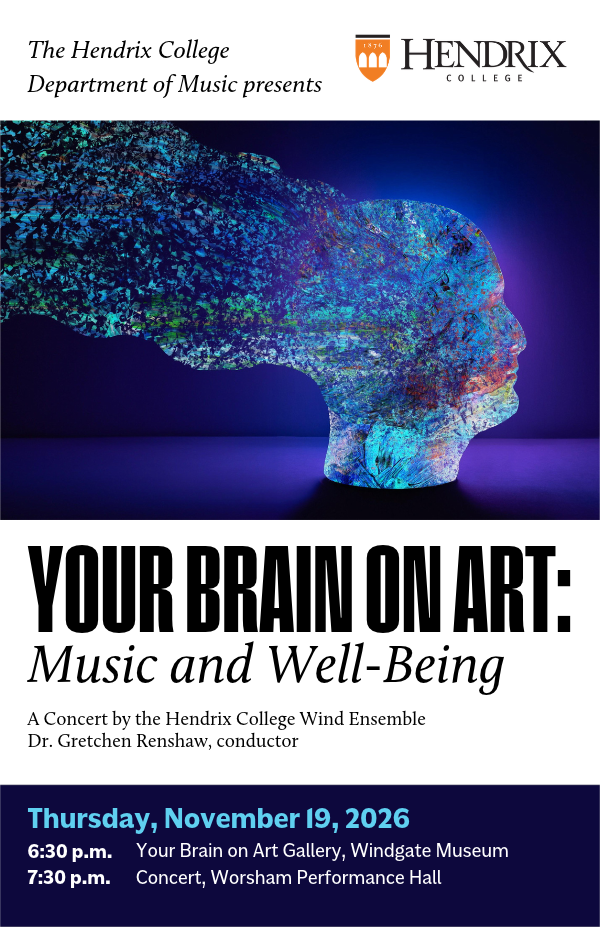
The research is continuing at Hendrix, with another “Your
Brain on Art” concert scheduled for Thursday, Nov. 19. Presented by the Hendrix
College Department of Music, “Your Brain on Art: Music and Well-Being” will
feature the Hendrix College Wind Ensemble under Renshaw's direction. The
evening begins at 6:30 p.m. with the “Your Brain on Art” gallery at the
Windgate Museum of Art, followed by the concert at 7:30 p.m. in Worsham
Performance Hall.
One area researchers hope to explore further is whether
audience members experience similar changes in stress, anxiety, and social
connection. The Nov. 19 concert will put that next step into practice, allowing
researchers to examine whether listeners experience changes in well-being
similar to those reported by performers.
“Last year’s concerts gave us promising evidence about
the experience of the performers,” Renshaw said. “This year, we’re expanding the
research to better understand the audience experience. We want to know whether
listeners experience some of the same changes in well-being that we saw in
performers. My hope is that people leave feeling differently than when they
walked in, and curious about why.”
For Renshaw, Merrick, and their student collaborators,
the work connects two parts of the Hendrix experience: the opportunity to
create art and the opportunity to ask questions about the world around us. And with
another concert approaching, there is still more to learn about what happens
when people come together to make music.
The full study is available in Arts at https://doi.org/10.3390/arts15100223. The research was funded by the Andrew W. Mellon
Foundation.
About
Hendrix College
Founded in 1876, Hendrix College is
featured in Colleges That Change Lives: 45 Schools That Will Change the Way
You Think About Colleges and celebrated among the country’s leading liberal
arts colleges for academic quality, engaged learning opportunities and career
preparation, vibrant campus life, and value. The College’s signature
career-readiness initiative, Via Hendrix, connects a transformative liberal
arts education with a four-year plan for life after college. Via Hendrix, every
student completes a full-time, semester-long professional co-op experience
before graduation.
The Hendrix experience extends
beyond the classroom, with students participating in 21 NCAA Division III
sports and a campus community shaped in part by the College’s longstanding
affiliation with the United Methodist Church, dating to 1884. As Hendrix
celebrates its Sesquicentennial in 2026–2027, the College is marking 150 years
of educating students while looking ahead to its next chapter. Learn more at via.hendrix.edu.
“… Through engagement that links the
classroom with the world, and a commitment to diversity, inclusion, justice,
and sustainable living, the Hendrix community inspires students to lead lives
of accomplishment, integrity, service, and joy.” –Hendrix College Statement of
Purpose